The Saint of Miracles, Unity, and Eternal Faith
Who was Shirdi Sai Baba? Was he a Hindu saint? A Muslim fakir? A divine incarnation? Over a century after he left his mortal body, the answer remains a beautiful mystery. But for millions of devotees across the globe, the answer is simple: He is Baba—the father, the protector, and the ultimate guide.
In a world often divided by religion and caste, Shirdi Sai Baba stands as a timeless beacon of unity, preaching the profound truth of “Sabaka Malik Ek” (One God Governs All). This article explores the life, Sai Baba miracles, and enduring teachings of the Saint of Shirdi, guiding you through a spiritual journey that continues to transform lives today.
The Mysterious Origins of the Fakir of Shirdi
One of the most captivating aspects of Sai Baba’s biography is the shroud of mystery surrounding his birth. Unlike most historical figures, there are no authentic records of his birth date, birthplace, or parents. He appeared in the village of Shirdi (Maharashtra, India) as a young boy of sixteen, seated under a Neem tree, absorbed in deep meditation.
Villagers were astonished. Who was this young ascetic who feared neither heat nor cold? After a brief disappearance, he returned to Shirdi in 1858 with a wedding procession. It was then that a local temple priest, Mhalsapati, welcomed him with the words, “Ya Sai!” (Welcome, Saint). From that moment on, he was known as Sai Baba.
He dressed like a Muslim fakir but quoted Hindu scriptures. He lived in a dilapidated mosque he called Dwarkamai (a Hindu name) but kept a sacred fire (Dhuni) burning eternally—a practice common in Nath Yoga. He was a living bridge between faiths, proving that the path to the Divine is universal.
If you summarize Sai Baba’s teachings into two words, they would be Shraddha (Faith) and Saburi (Patience). These are not just concepts but the “two coins” he often asked from his devotees as dakshina (offering).
Core Teachings: The Path of Shraddha and Saburi
- Shraddha (Unwavering Faith)
Baba taught that faith is not just belief; it is the courage to stand strong when life falls apart. To have Shraddha means to trust that Baba is listening to every prayer and that his protection is absolute. - Saburi (Patience and Perseverance)
He often said, “Allah Bhala Karega” (God will do good), reminding devotees that patience is essential. Desires and prayers are answered not when we want them, but when the time is right. Saburi is the spiritual stamina required to wait for the Divine grace without losing hope. - Sabka Malik Ek (One God Governs All)
Perhaps his most famous Sai Baba quote, this mantra shattered the walls between Hindus and Muslims. He celebrated Rama Navami and Eid with equal fervor, teaching that God is one, regardless of the name we use to call Him.
Sai Baba Miracles: When the Impossible Became Possible
The stories of Sai Baba miracles are legendary and form the backbone of the Sai Satcharitra (the holy biography of Sai Baba). These stories are not just displays of power but acts of immense compassion.
The Miracle of Lighting Lamps with Water
This is perhaps the most searched and beloved Sai Baba story. One Diwali, the local shopkeepers refused to give Baba oil for his lamps, mocking his poverty. Unfazed, Baba returned to Dwarkamai, filled his earthen lamps with water, and drank a sip before pouring the rest into the lamps. To the shock of the villagers, the lamps burned brightly throughout the night! The water had turned into oil by the power of his will. This miracle humbled the shopkeepers and established him as a divine master.
Stopping the Rain
Once, a terrible storm hit Shirdi, terrifying the villagers and livestock. They rushed to Dwarkamai, begging for help. Baba stepped out to the edge of the mosque and roared at the storm, “Stop your fury! Calm down!” Within moments, the rain ceased, and the sky cleared.
Healing the Sick
Baba often served as a physician, but his medicine was unconventional. He used Udi (sacred ash from his Dhuni) to cure incurable diseases. Even today, devotees believe that applying Udi with faith can heal physical and mental ailments.
Shirdi: A Virtual Pilgrimage
Today, Shirdi is one of the world’s most visited pilgrimage sites. If you are planning a visit, here are the sacred spots you must know:
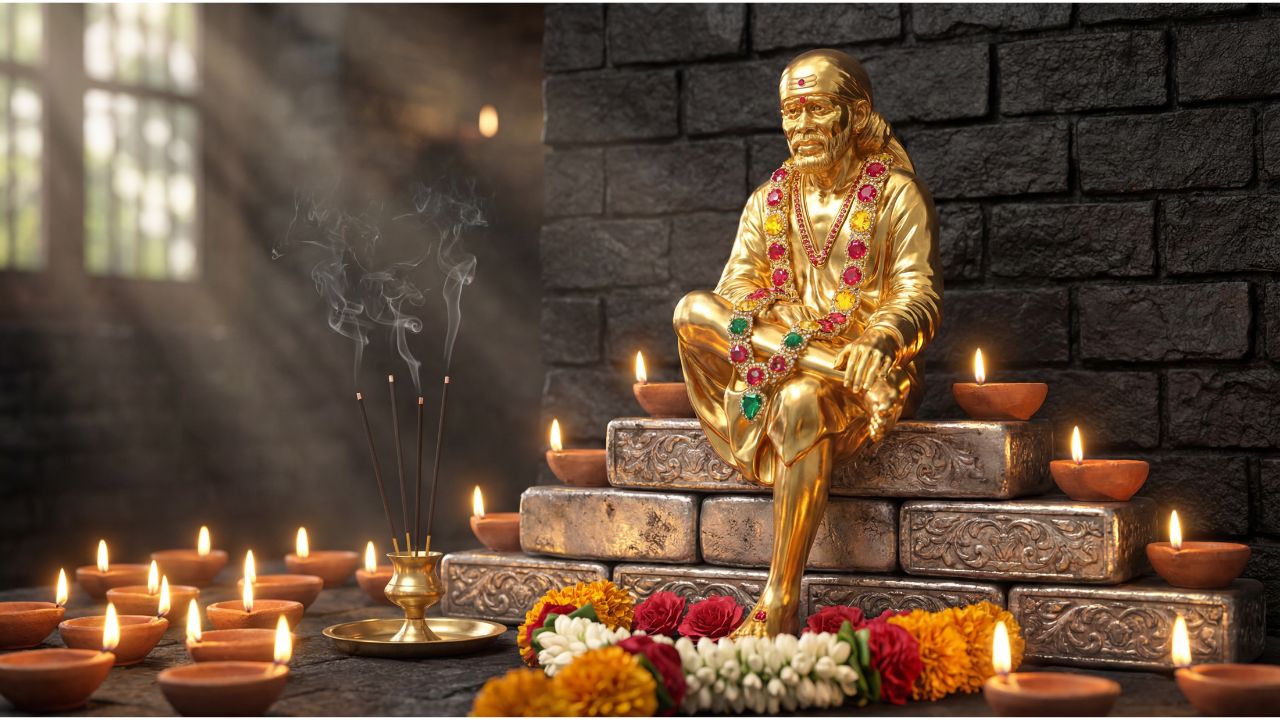
Samadhi Mandir: The main temple where Sai Baba’s mortal remains are interred. The life-like white marble statue here is the focus of the daily Sai Baba Aarti.
Dwarkamai: The mosque where Baba lived for 60 years. It is unique because it houses a temple inside a mosque. The sacred Dhuni (fire) lit by Baba continues to burn here today.
Gurusthan: The place under the Neem tree where Baba was first seen as a boy. It is said that burning incense here heals ailments.
Chavadi: The building where Baba slept every alternate night. The weekly Thursday procession (Palkhi) from Dwarkamai to Chavadi is a vibrant tradition.
Worship in the Modern Era: Connecting with Sai
You do not need to be in Shirdi to connect with him. Baba famously promised, “I shall be active and vigorous even from the tomb.” Here is how modern devotees keep the connection alive:
Sai Baba 9 Thursday Vrat: A popular fast observed for nine consecutive Thursdays to fulfill wishes.
Reading the Sai Satcharitra: Devotees engage in Parayan (reading the biography) to find answers to their problems. It is believed that the book holds the solution to every dilemma.
Chanting and Bhajans: Listening to Sai Baba Bhajans or chanting “Om Sai Ram” is considered the easiest way to meditate and find peace.
Conclusion: The Ever-Living Legacy
Shirdi Sai Baba is not a figure of the past; he is a presence of the present. His life was a demonstration that God is simple, accessible, and loving. He did not ask for complex rituals or expensive gifts. He asked for love, he asked for kindness to others, and he asked for faith.
Whether you are seeking a miracle, looking for spiritual guidance, or simply need a friend in difficult times, look towards Shirdi. As millions will testify, when you take one step towards Baba, he takes ten steps towards you.
“If you look to me, I look to you.” — Shirdi Sai Baba